THINK: The user wants me to rewrite a title in Portuguese for Google Discover.
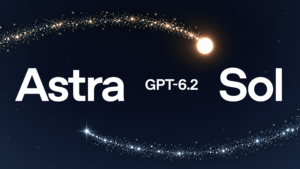
The original title is "Introducing GPT-6.2 Astra and Sol".
The new title needs to be:
- In Portuguese.
- Short.
- Curious.
- No introductions or lists, just the final text.
Let’s break down the original title:
- "Introducing": Signals a new product/release.
- "GPT-6.2": The core technology/product name.
- "Astra and Sol": Specific model names or features.
Google Discover titles thrive on:
- Intrigue
- Questions (implied or direct)
- Strong verbs/adjectives
- Sense of urgency/novelty
Portuguese translation ideas:
- "Introducing": Chegou, Conheça, Apresentando, Revelado
- "GPT-6.2": Can be kept as is, or simplified.
- "Astra and Sol": Can be kept, or used as a hook.
Let’s try some options:
Option 1 (Direct + Curious):
"GPT-6.2: Conheça Astra e Sol!" (GPT-6.2: Meet Astra and Sol!) – A bit bland.
Option 2 (Focus on novelty):
"Chegou GPT-6.2: Astra e Sol vão te surpreender!" (GPT-6.2 arrived: Astra and Sol will surprise you!) – A bit long.
Option 3 (More intriguing, short):
"GPT-6.2: O que são Astra e Sol?" (GPT-6.2: What are Astra and Sol?) – Good, short, curious.
Option 4 (Emphasis on "new era"):
"Astra e Sol: A nova era do GPT-6.2?" (Astra and Sol: The new era of GPT-6.2?) – Good, uses the names as the hook.
Option 5 (Short and direct with impact):
"GPT-6.2: Chegaram Astra e Sol!" (GPT-6.2: Astra and Sol have arrived!) – A bit too direct, not very curious.
Option 6 (Focus on the who):
"GPT-6.2: Quem são Astra e Sol?" (GPT-6.2: Who are Astra and Sol?) – Very curious, short. This implies they are entities or powerful new features. Given "Astra" and "Sol" are often used for powerful entities (stars, space), this works well.
Option 7 (Focus on the what they bring):
"Astra e Sol: O futuro do GPT-6.2?" (Astra and Sol: The future of GPT-6.2?) – Also good, future-oriented.
Comparing Option 3 ("O que são Astra e Sol?") and Option 6 ("Quem são Astra e Sol?"):
"Quem são Astra e Sol?" feels more personal and intriguing, as if they are new characters or powerful entities within the GPT world. It creates more wonder. "O que são" is more generic. For Google Discover, the "who" angle often performs better if the names sound like they could be agents or powerful features.
Let’s consider "Astra" (star, space) and "Sol" (sun). These are evocative names. "Quem são" works perfectly to build mystery around these powerful-sounding new additions.
Final check:
- In Portuguese: Yes.
- Short: Yes.
- Curious: Yes, "Quem são?" is highly curious.
- No introductions/lists: Yes, just the title.
"GPT-6.2: Quem são Astra e Sol?" looks like a strong candidate.
Another one that might work: "Astra e Sol: Prepare-se para o GPT-6.2!" (Astra and Sol: Get ready for GPT-6.2!). This is also good, but "Quem são" creates more immediate intrigue.
Let’s stick with the "Who are they?" angle. It’s concise and piques interest effectively for new, named entities.
Consider the user’s explicit instruction: "Retorne APENAS o texto do título final, sem introduções ou listas".GPT-6.2: Quem são Astra e Sol?